Impact windows cost $650 to $1,200 per window installed for standard sizes, and $3,000 to $8,000 for a large impact-rated sliding glass door. Figure roughly 40 to 70 percent more than the equivalent non-impact window. On a typical whole-home project of 12 to 18 openings, that is a $12,000 to $30,000 conversation.
The reason for the premium is not marketing. It is laminated glass and a frame built to hold that glass in the opening after a piece of somebody's fence has hit it at highway speed.
What you are actually buying
An impact window is two things working together:
Laminated glass. Two glass panes permanently bonded to a plastic interlayer, usually polyvinyl butyral or a stiffer ionoplast interlayer for higher-performance units. The glass breaks. The interlayer holds the fragments in a sheet, so the opening stays sealed.
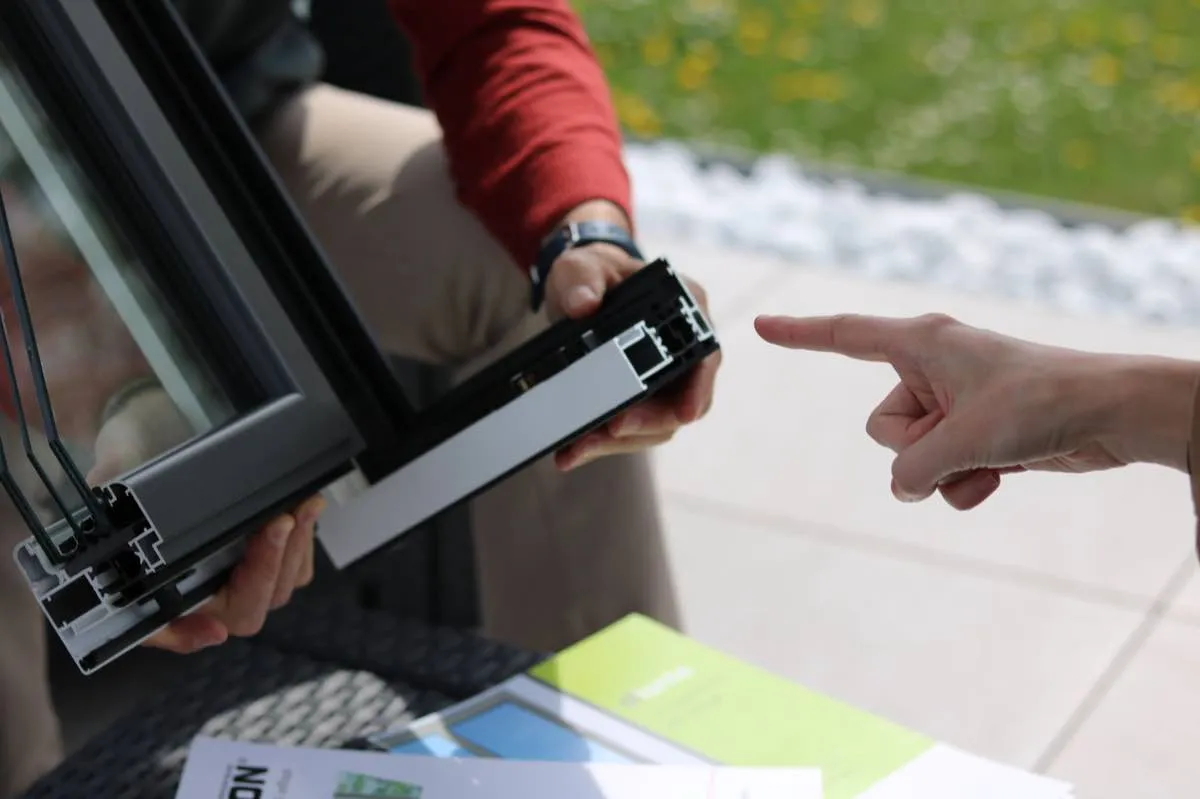
A frame engineered to hold it. This is the half people forget. Laminated glass in an ordinary frame simply gets pushed out of the frame as an intact pane, which does not help. The whole assembly is tested and approved together.
Keeping the building envelope closed is the entire point. Once wind gets inside a house through a broken opening, internal pressure builds and it starts trying to lift the roof off from the inside. Protecting openings is protecting the structure.
The testing, in plain terms
Product approval runs on ASTM E1886 and E1996. The headline test is the large missile impact: a nine-pound piece of two-by-four fired at roughly 34 miles per hour at the assembly, followed by several thousand positive and negative pressure cycles simulating hours of storm loading.
Openings more than 30 feet above grade may qualify under small missile testing instead, using steel balls, on the reasoning that lumber is not usually airborne at that height.
Two more things to look for on the label:
- Design Pressure (DP) rating. How much wind load the unit is rated to take. This must match what your local code requires for your building's exposure and height, and it is not one number for the whole country.
- Product approval number. Coastal jurisdictions maintain approval systems — a Notice of Acceptance in the High Velocity Hurricane Zone, statewide product approval elsewhere. If a salesperson cannot produce the approval number, that is the end of the conversation.
What drives your price
| Factor | Effect on cost |
|---|---|
| Opening size | The biggest driver. Laminated glass price scales fast with area |
| Sliding doors | The single most expensive openings in the house |
| Frame material | Vinyl lowest, aluminum mid, fiberglass and clad highest |
| Design pressure required | Higher DP means heavier frames and thicker laminate |
| Impact plus low-E | Usually the right combination, adds modest cost |
| Full-frame vs insert | Full-frame is required more often in impact work |
| Permit and engineering | Real line items in coastal jurisdictions |
Impact windows vs shutters
This is the honest comparison, and it is closer than either salesperson will admit.
| Impact windows | Shutters / panels | |
|---|---|---|
| Cost, whole home | $12,000–$30,000+ | $3,000–$12,000 |
| Protection when deployed | Equivalent | Equivalent |
| Requires action before a storm | No | Yes, every time |
| Works when you are away | Yes | No |
| Daily light and view | Unchanged | Unchanged when open |
| Noise and UV benefit | Substantial | None |
| Insurance credit | Usually yes | Usually yes |
Our take: buy impact windows if you travel, if deploying panels is physically difficult, or if your windows are due for replacement anyway. That last condition is the one that changes the math completely — if you are already spending $500 a window, the impact upgrade is a few hundred more per opening rather than a whole new project.
Buy shutters if your existing windows are in good condition and you are home for storms. Spending $20,000 to replace serviceable windows for protection you could get for $6,000 is not a good trade, and we will say so on a site visit.
The benefits nobody buys them for and everybody notices
Laminated glass does three things that have nothing to do with weather:
- Noise. The interlayer damps sound transmission in a way an air gap does not. Homes near a highway, a flight path, or a busy road notice this within a day.
- UV. Laminated interlayers block the overwhelming majority of ultraviolet light, which is why flooring and furniture near impact glass fade far more slowly.
- Security. Breaking through laminated glass takes sustained, loud, obvious effort. It is not bulletproof. It is deeply inconvenient to a burglar.
Inland, these are the actual reasons to consider impact glass, and they are better reasons than a storm that may never come.
Questions to ask before you sign
- What is the DP rating and does it meet the requirement for my exposure?
- What is the product approval number? Look it up yourself.
- Is the glass laminated, or is this "hurricane resistant" marketing language? Laminated is a specific thing.
- Insert or full-frame? Impact assemblies often need full-frame installation with proper anchoring into the structural opening. Anchoring is where these installations fail.
- What is the SHGC? In a hot climate you want impact and solar control together. See our energy-efficient window guide for what those label numbers mean.
- What exactly does my insurer credit? In writing, before the deposit.
Where people waste money
Protecting some openings and not others. The envelope is only as strong as the weakest opening. A house with impact windows and an unprotected patio slider is a house with an unprotected patio slider.
Assuming the garage door is fine. It is usually the largest and weakest opening on the building. Often the highest-value upgrade in the whole project, and it is not a window.
Buying on brand rather than on the approval documents. The label and the DP rating tell you what you bought. The brochure does not.
Ontario Window Replacement installs impact and hurricane-rated windows and impact sliding patio doors across Ontario and the West End of the Inland Empire, and we will tell you honestly when shutters make more financial sense for your house. For general pricing, see our new window cost guide.
Get a free quote → · call (844) 422-0623
Ready for a free quote in Ontario?
Ontario Window Replacement — free estimate, clear scope, no pressure. Use the form on this page or jump to the homepage quote.
Related services in Ontario
Ontario Window Replacement money pages — go straight to the service you need.
- Energy-Efficient Glass for Homes and Suites →
Energy-efficient glass pays back on a schedule, and the two buildings we work on keep opposite schedules. A house in Ontario sits empty at two in the afternoon and full at eight at night.
- Laminated Security and Impact Glazing →
We are going to argue against half of what this page is usually used to sell. Ontario is fifty miles inland in San Bernardino County.
- Sliding Patio Doors →
The patio slider is the heaviest moving thing in most Ontario houses and the one that gets used every day. When people say their door is broken, nine times out of ten the glass is fine and the rolling system underneath it has been dead for years.
- Vinyl Window Replacement →
Vinyl is the correct answer for most houses in Ontario and the wrong answer for almost every storefront. That sentence is the whole page, but the reasons behind it decide whether you get a window that lasts thirty years or one that sags in eight.
- Fiberglass Window Replacement →
Fiberglass exists to solve three specific problems: dark colors at large sizes, thin sightlines on a wide opening, and a frame that will accept paint later. If none of those apply to your house, you are about to spend money for nothing.
Frequently asked questions
How much do impact windows cost per window?
Most impact-rated windows run $650 to $1,200 installed for a standard size, roughly 40 to 70 percent more than a comparable non-impact vinyl unit. Large fixed picture units and impact sliding glass doors are the budget shock — a big impact slider commonly lands between $3,000 and $8,000 installed.
What makes a window impact rated?
Laminated glass — two panes bonded to a tough interlayer, typically PVB or an ionoplast — inside a frame engineered to hold that glass in place under pressure. The glass can crack. It is designed to stay in the opening after it does, which is what keeps the wind out of your house.
How are impact windows tested?
Under ASTM E1886 and E1996, a large missile test fires a nine-pound two-by-four at the assembly at roughly 34 miles per hour, followed by thousands of pressure cycles simulating a storm. Small missile testing uses steel balls for openings above 30 feet. Passing means the assembly stayed intact, not that the glass stayed pretty.
Are impact windows worth it if I am not on the coast?
If you are outside a wind-borne debris region, probably not for storm protection alone. What still makes them attractive inland is the laminated glass itself — meaningful noise reduction, near-total UV blocking, and forced-entry resistance. Buy them for those reasons, not for a hurricane that is unlikely to reach you.
Do impact windows lower my insurance?
Often, in coastal states. Several require insurers to offer windstorm mitigation credits for approved opening protection, and the credit can be substantial on a coastal policy. Get the specific credit quoted by your insurer before you buy, in writing, because it varies enormously.
Are impact windows better than shutters?
Not better, different. Shutters cost roughly a third as much and protect equally well when deployed. Impact windows cost more and protect whether or not anyone is home to close anything. If you travel, or you are older, or the second-floor shutters are a two-person job, that difference matters.
Local context
How this applies in Ontario, CA
Every article here is written from window work done in Ontario and the West End of the Inland Empire, so the numbers reflect local labour, permit and material costs rather than a national average. Your own job can land either side of them depending on access, the condition of what is already there, and the materials you pick — center-set aluminum storefront framing in 1-3/4 by 4-1/2 inch profiles, dry-glazed EPDM gaskets and wet-glazed structural silicone joints, subsill flashing with end dams under storefront base members.
The way to turn any of this into a real answer is to have someone look at your actual situation. The free estimate is free, itemized and written down, with no deposit and no obligation. Call (844) 422-0623 or start on the Ontario Window Replacement homepage.
Areas Ontario Window Replacement covers
Ontario first, then the surrounding communities of the West End of the Inland Empire. Each has its own page with local detail rather than a copy of this one:
- Chino, CA — San Bernardino County, incorporated in 1910, population 91,403 at the 2020 census, with dairy-preserve land on the south side turning over to distribution buildings
- Chino Hills, CA — San Bernardino County, incorporated in 1991, population 78,411 at the 2020 census, almost entirely built after 1980 and overwhelmingly residential
- Montclair, CA — San Bernardino County, incorporated in 1956, population 37,865 at the 2020 census, in a five and a half square mile footprint dominated by retail frontage
- Upland, CA — San Bernardino County, incorporated in 1906, population 79,040 at the 2020 census, with a pre-war downtown core and hillside tracts above Foothill Boulevard
- Pomona, CA — Los Angeles County, incorporated in 1888, population 151,713 at the 2020 census, the largest city in the Pomona Valley and the oldest housing stock we cover
- Claremont, CA — Los Angeles County, incorporated in 1907, population 37,266 at the 2020 census, with a walkable village core and a large protected residential historic district
Or jump to the full list of Ontario services.
More from the Ontario Window Replacement blog
- How to Install Replacement Windows in Ontario, CA
How to install replacement windows in Ontario, CA: an insert takes a confident DIYer a few hours; full-frame is a pro job. Steps, tools, when to call.
- Are Energy Efficient Windows Worth It in Ontario, CA?
Are energy efficient windows worth it in Ontario, CA? How to read the NFRC label and the honest payback math nobody shows you.
- How Much Do New Windows Cost? (Ontario, CA Guide)
New windows in Ontario, CA run about $400 to $900 per window installed for standard vinyl. Here's the cost by material, type, and size — no sales math.
The Ontario Window Replacement Team
window specialists serving Ontario, CA
Written by the Ontario Window Replacement team — insured window pros serving Ontario, CA and the surrounding area.